An accessible document, authored with components
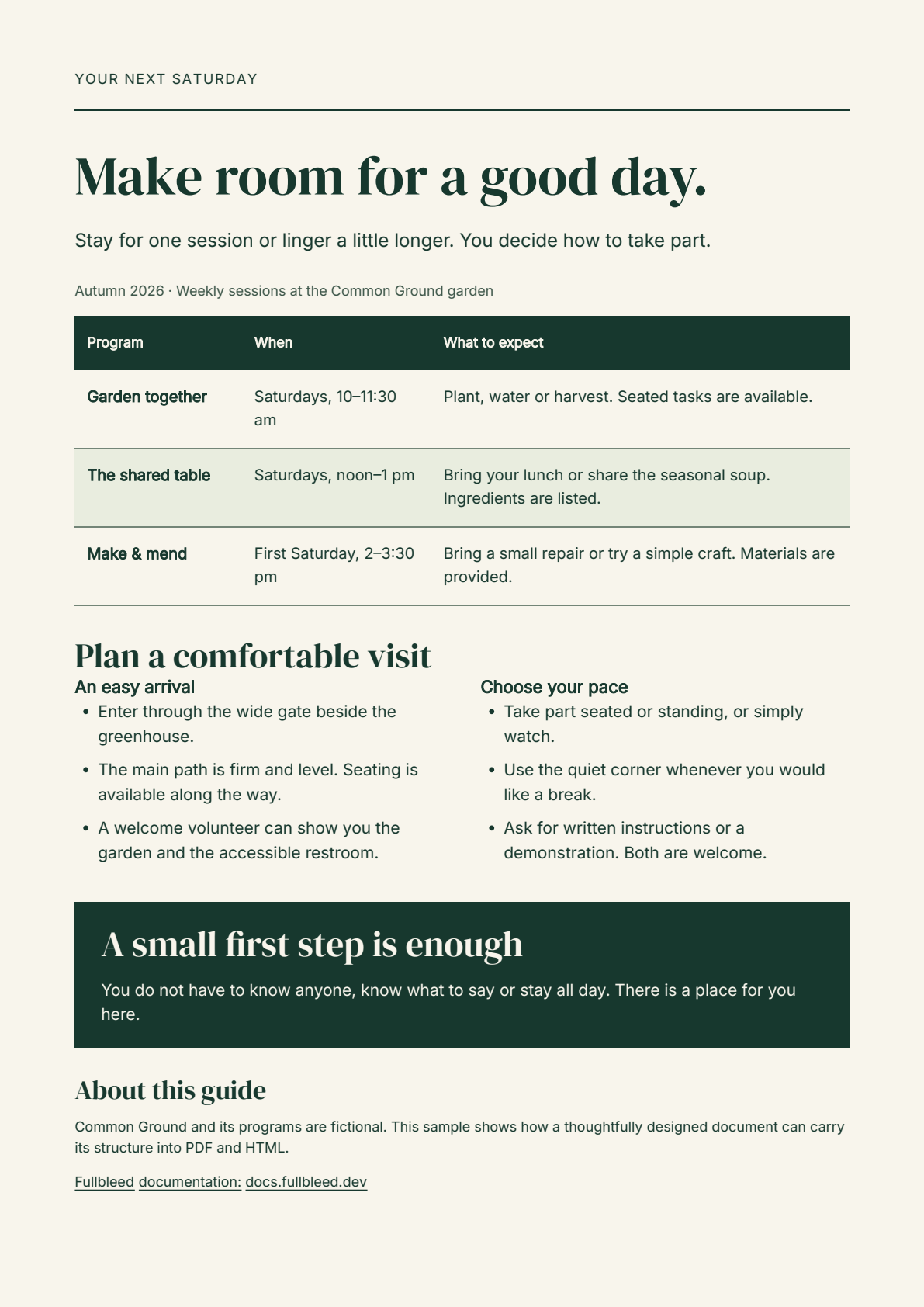
Common Ground is a fictional community-program guide: an illustrated cover, reusable program cards, a captioned schedule and practical visitor information. Its Python source carries headings, table headers, lists and an image description through to the final PDF.
Read the PDF Download the source kit Open the responsive HTML
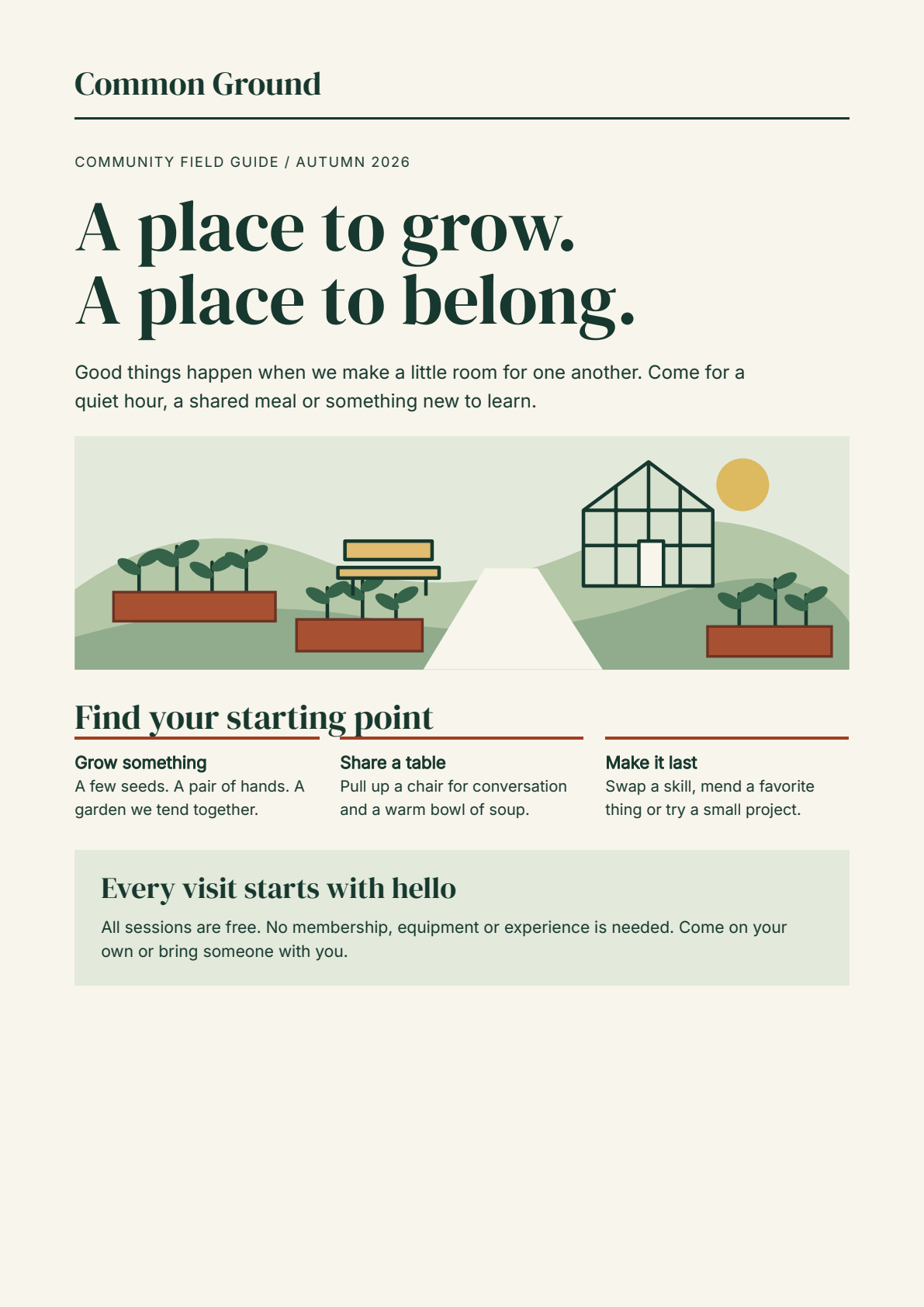
View the schedule and visitor-information page.
Pinned component alpha
The kit uses fullbleed.ui.experimental from 2.6.0a4. Its API may change
before stabilization. The PDF and all verification receipts below refer to
this specific published specimen.
Build it and make it yours
Unzip the source kit, open its folder and run:
The PDF appears at output/common-ground-guide.pdf. Edit the SCHEDULE records
or compose another card:
from guide import ProgramCard

card = ProgramCard(
    "Grow something",
    "A few seeds. A pair of hands. A garden we tend together.",
)
ProgramCard owns its section and H3. ProgramSchedule uses DataTable and
Column to turn records into a table with a caption and scoped column headers.
BulletList preserves list semantics; the illustration uses Image(alt=...).
The source needs no raw HTML strings.
Styling and HTML export
class_name="program-card" emits the authored CSS class. Its appearance comes
from .program-card in guide.css, loaded with Document(styles=...).
The class name does not load a stylesheet automatically.
guide.css owns the print design. browser.css adds the responsive presentation
only to browser exports; Page(size="A4", margin=mm(0)) owns the PDF geometry.
from guide import build_document

document = build_document(browser=True)
styled = document.to_html(include_styles=True, a11y_mode="raise")
unstyled = document.to_html(include_styles=False, a11y_mode="raise")
Open the unstyled HTML to see the semantic document without CSS. It retains authored class names, text, alt text and the link, so another application can supply its own presentation. The render command copies the local fonts and illustration beside both exports.
What was checked
The final two-page PDF passed veraPDF 1.30.3's PDF/UA-1 validation profile: 106 passed rules, 5,326 passed checks, zero failures and no diagnostic warnings. The receipt identifies the exact PDF by SHA-256.
| Check | Result |
|---|---|
| Actual PDF structure and marked-content text | One H1, continuous H2/H3 hierarchy, expected logical reading order |
| Marked-content boundaries | Balanced tags, no nested IDs; retained faulty PDF rejected |
| Image | One tagged figure with the authored description |
| Schedule | One table, three column headers with /Scope /Column, nine data cells |
| Lists | Two lists containing six items |
| Fonts, metadata and geometry | Embedded fonts, English language, document title, two A4 pages; no overflow or missing-glyph/font-substitution gate failures |
| Reproduction | Identical PDF bytes on repeat rendering and through the exported HTML/CSS path |
| Visual review | Both pages inspected in native and independent PDFium previews |
| Styled HTML | Checked at 1440, 390 and 320 pixels; no horizontal overflow; keyboard link focus verified |
| Unstyled HTML | Semantic elements and authored classes retained; no CSS or inline style declarations |
| Authored text colors | Minimum contrast ratio 7.45:1 across the design's text/background pairs |
Validation receipt · veraPDF report · PDF tag and reading-order report · Verifier failure control · Browser checks · Source manifest
These checks are not a screen-reader user test or blanket WCAG certification.
The kit includes verify.py to inspect the actual output again after edits.
It rejects nested marked-content IDs and unbalanced tag boundaries even without
veraPDF. The pinned alpha has a known issue with component content inside table
cells; this
specimen uses plain cell text with CSS styling. The kit's check rejects a retained
earlier PDF that demonstrates the issue.
For an external check, run veraPDF's UA-1 profile
on the final PDF:
The pinned runtime exports HTML links as plain PDF text, so this document also writes out its destination URL. Redundant decorative folios and card numbers are omitted because paragraph ARIA attributes do not reliably remove that text from the PDF's tags in this alpha. The browser export has a descriptively named link. The two-page print layout should be rechecked after content changes.
For another way to author the same design, see the paired Northstar and Common Ground examples.