Reuse your design on every page
A document's header can use the same brand component as its body. Its footer can
carry a styled page count that updates after pagination. Fullbleed 2.6.0a9
adds PageBand and PageNumbers to the experimental Python component API.
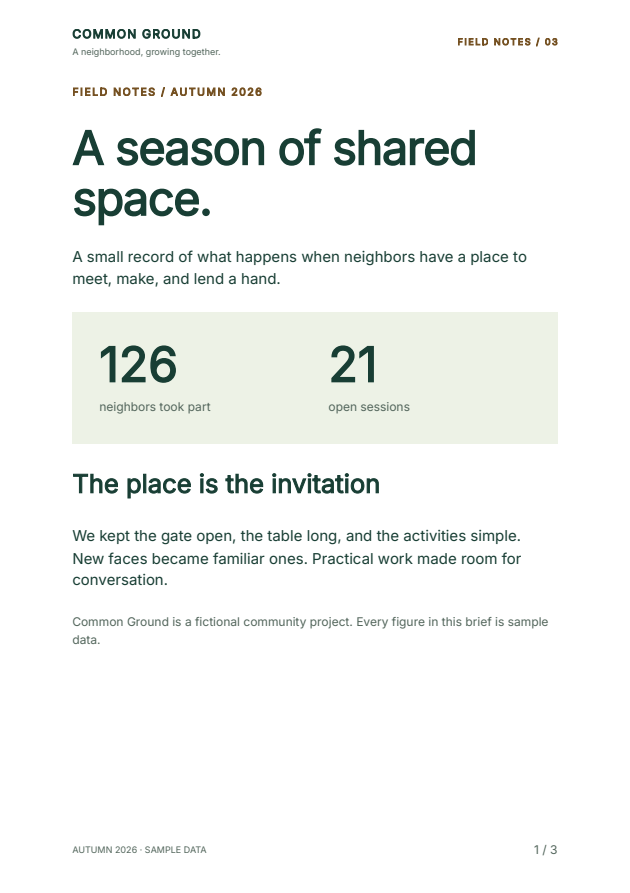
The Common Ground field-notes example combines a shared theme, reusable brand and metric components, a table, and three numbered pages. Edit its Python functions and data to make it your own.
Download the complete source kit Open the field-notes PDF Try the page-band notebook
Install the preview explicitly
Use Python 3.10 or later in a virtual environment. The kit pins
fullbleed==2.6.0a9; ordinary pip install fullbleed selects the stable
channel. Components under fullbleed.ui.experimental may change.
Run the report
Extract the ZIP, open its fullbleed-component-showcases-2.6.0a9 folder, and run:
python -m pip install -r requirements.txt
python component_page_bands/render.py --out output/field-notes --pdf-profile pdfua2
Open output/field-notes/field-notes.pdf, field-notes.html, or
field-notes-unstyled.html. The PDF has repeating bands and page values such as
1 / 3. HTML has one semantic header, main and footer, with explicit
[page] / [pages] placeholders. It does not paginate the browser.
The content is fictional. Fonts come from the pinned package or the source kit;
PDF generation does not need a browser or system fonts. Choose --pdf-profile
tagged for ordinary tagged PDF, or pdfua1 for the other accessible profile.
Give the margins reusable components
This complete example creates a PDF with a branded header and a numbered footer:
from importlib.resources import files
from pathlib import Path
from fullbleed.ui.experimental import (
    Document, Heading, Page, PageBand, PageNumbers, Paragraph, Renderer,
    Theme, component, mm, pt, style,
)

@component
def Brand(name):
    return Paragraph(name, style=style(font_size=pt(8), font_weight=700))

document = Document(
    Heading("Project summary", level=1),
    Paragraph("Prepared by Northstar Studio."),
    title="Project summary",
    lang="en-US",
    theme=Theme(text=style(font_family="Inter", font_size=pt(10))),
    page=Page(
        "A4", margin=mm(20),
        header=PageBand(left=Brand("NORTHSTAR STUDIO")),
        footer=PageBand(right=PageNumbers(total=True, class_name="folio")),
    ),
    styles={".folio": style(font_size=pt(8), color="#53665c")},
)
font = files("fullbleed_assets").joinpath("fonts/Inter-Variable.ttf")
renderer = Renderer(font_files=[str(font)])
Path("summary.pdf").write_bytes(document.render_pdf(renderer))
Path("summary.html").write_text(document.to_html(include_styles=True), encoding="utf-8")
Path("summary.unstyled.html").write_text(document.to_html(include_styles=False), encoding="utf-8")
class_name="folio" adds the literal class. The matching .folio rule in
Document(styles=...) supplies its appearance. Components also accept style=;
.with_style(...) customizes their root and .with_parts(...) customizes named
internal elements. In the complete report, Brand, Metric and NextStep
expose parts, and styled(...) defines reusable typography.
Page reserves the margins. A band does not enlarge them automatically. It
accepts left, center and right slots, with first_page and blank_pages
policies. A PageNumbers value occupies its own slot. Managed bands report
layout or conservative paint-bound failures with the page, slot and authoring
source. Register fonts explicitly so those checks can use the actual glyphs.
See the page-band API and limits for per-record numbering, fit diagnostics, styling precedence and export behavior.
Keep both authoring paths
The same kit also includes the existing Northstar invoice, Common Ground report and authored accessible community guide:
python design_showcase/compare_authoring.py --out output/paired
python accessible_showcase/render.py --out output/accessible-ua1
python accessible_showcase/render.py --pdf-profile pdfua2 --out output/accessible-ua2
Northstar and the report each include component and HTML/CSS sources for the same design. The paired command compares the rendered pages and writes styled and unstyled HTML. The guide demonstrates headings, captioned tables, column headers, lists and image descriptions. Bootstrap components remain static, including HTML export; no Bootstrap JavaScript is included.
The paired-authoring walkthrough,
accessible-guide walkthrough, and
Bootstrap catalog retain their versioned
examples. The alpha 8 guide documents the earlier package,
which does not include PageBand or PageNumbers.
Verification and scope
The release evidence links source provenance, checksums, saved-output comparisons and independent PDF/UA validator reports. The source ZIP is tested after extraction using a fresh public package installation.
The component source retains 1,480 native tests, 11 doctests and 970 Python tests. Its 33-case page-band matrix includes per-record numbering, styled number comparisons, first/blank-page policies and rejected inputs. Earlier saved-PDF fixtures and the designed showcases retain their reviewed output. The complete CSS comparison retains its 25 failed cases and 18 disputed references.
Repeated bands are artifacts outside the PDF body reading order. Keep essential identity and report details in the body as well. Profile selection and passing specimens do not establish accessibility for arbitrary documents or human assistive-technology usability. Fit checks are conservative; named/facing-page band variants are outside this API. Native streaming output is not atomic.